Hello, Sign in
My Account
My Account
New customer? Start here

| Catalog # | Availability | Size | Quantity | Unit Price | Save For Later Wish List | |
|---|---|---|---|---|---|---|
| ABZ1994-100 | 2 weeks | 100 µL | $499.00 |
Select product before adding to cart
|
||
| ABZ1994-20 | 2 weeks | 20 µL | $149.00 |
Product Overview | |
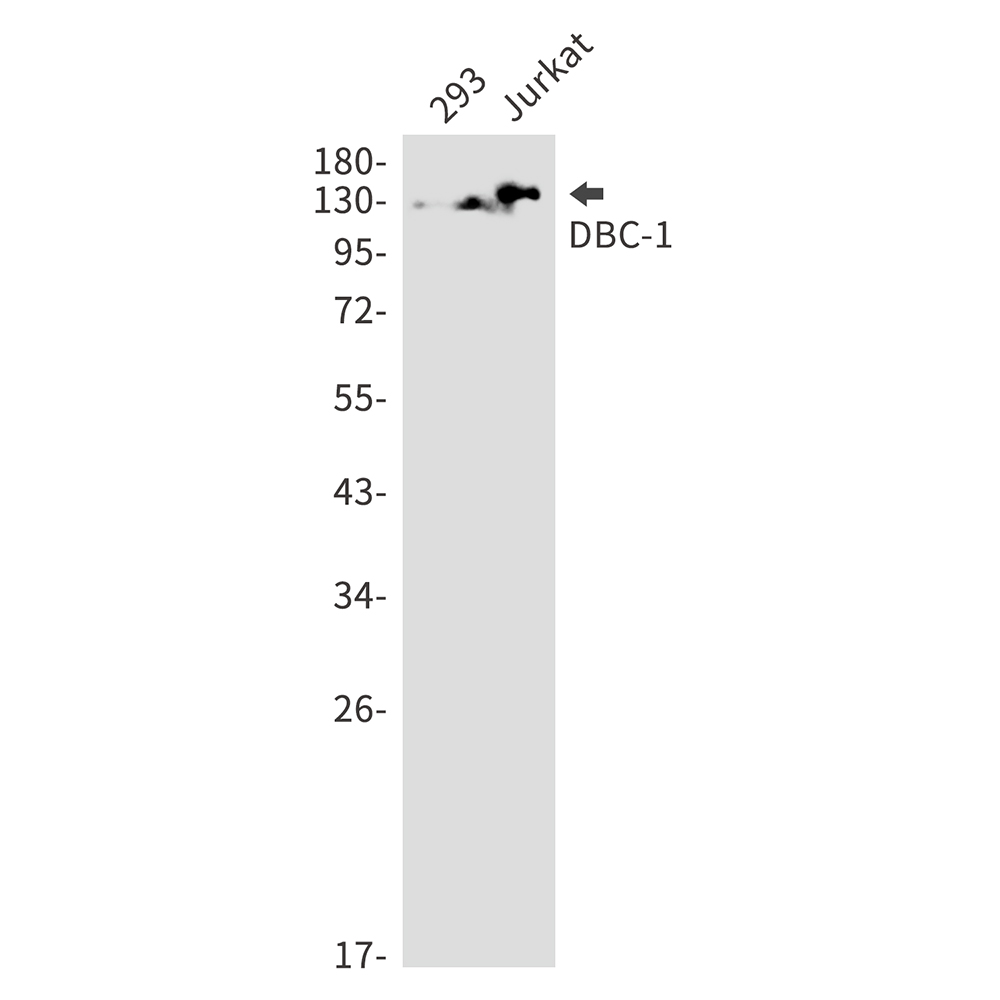
| Name | DBC 1 Rabbit mAb |
|---|---|
| Accession (Primary) | Q8N163 |
| Host Species | Rabbit |
| Clonality | Monoclonal |
| Isotype | IgG |
| Species Reactivity | |
| Reacts With | Human |
| Calculated MW | |
| Calculated MW: 103 kDa; Observed MW: 130 kDa | |
| Buffer System | |
| Liquid in 50mM Tris-Glycine(pH 7.4), 0.15M NaCl, 40%Glycerol, 0.01% sodium azide and 0.05% BSA. | |
| Storage | |
| Store at 4°C short term. Aliquot and store at -20°C long term. Avoid freeze/thaw cycles. | |
| Recommended Dilution | |
| WB-1:500-1:1000; IHC-P-1:200-1:2000; ICC/IF-1:200-1:500; FC-1:200-1:1000; IP-1:20-1:50 | |
| Purification | |
| Affinity Purified | |
| Conjugation | |
| Unconjugated | |
| Modification | |
| Unmodified | |
| Form | |
| Liquid | |
| Background | |
| Core component of the DBIRD complex, a multiprotein complex that acts at the interface between core mRNP particles and RNA polymerase II (RNAPII) and integrates transcript elongation with the regulation of alternative splicing: the DBIRD complex affects local transcript elongation rates and alternative splicing of a large set of exons embedded in (A + T)-rich DNA regions. Inhibits SIRT1 deacetylase activity leading to increasing levels of p53/TP53 acetylation and p53-mediated apoptosis. Inhibits SUV39H1 methyltransferase activity. As part of a histone H3-specific methyltransferase complex may mediate ligand-dependent transcriptional activation by nuclear hormone receptors. Plays a critical role in maintaining genomic stability and cellular integrity following UV-induced genotoxic stress. Regulates the circadian expression of the core clock components NR1D1 and ARNTL/BMAL1. Enhances the transcriptional repressor activity of NR1D1 through stabilization of NR1D1 protein levels by preventing its ubiquitination and subsequent degradation (PubMed:18235501, PubMed:18235502, PubMed:19131338, PubMed:19218236, PubMed:22446626, PubMed:23352644, PubMed:23398316). Represses the ligand-dependent transcriptional activation function of ESR2 (PubMed:20074560). Acts as a regulator of PCK1 expression and gluconeogenesis by a mechanism that involves, at least in part, both NR1D1 and SIRT1 (PubMed:24415752). Negatively regulates the deacetylase activity of HDAC3 and can alter its subcellular localization (PubMed:21030595). Positively regulates the beta-catenin pathway (canonical Wnt signaling pathway) and is required for MCC-mediated repression of the beta-catenin pathway (PubMed:24824780). Represses ligand-dependent transcriptional activation function of NR1H2 and NR1H3 and inhibits the interaction of SIRT1 with NR1H3 (PubMed:25661920). Plays an important role in tumor suppression through p53/TP53 regulation; stabilizes p53/TP53 by affecting its interaction with ubiquitin ligase MDM2 (PubMed:25732823). Represses the transcriptional activator activity of BRCA1 (PubMed:20160719). Inhibits SIRT1 in a CHEK2 and PSEM3-dependent manner and inhibits the activity of CHEK2 in vitro (PubMed:25361978). | |
Target Information: ( Q8N163 ) | |
| Name | CCAR2 |
| Gene ID | 57805 |
| Other Names | |
| DBC1; DBC-1; NET35; p30DBC; p30 DBC; KIAA1967 | |

Thousands of laboratories across the world have published research that depended on the performance of antibodies from ADMEbio to advance their research.
Check out links to articles that cite our products in major peer-reviewed journals, organized by research category.
Thank you,
ADMEbio Team


ADMEbio welcomes feedback from our customers.
Thank you,
ADMEbio Team