
Hello, Sign in
My Account
My Account
New customer? Start here


| Catalog # | Availability | Size | Quantity | Unit Price | Save For Later Wish List | |
|---|---|---|---|---|---|---|
| ABZ1688-100 | 2 weeks | 100 µL | $499.00 |
Select product before adding to cart
|
||
| ABZ1688-20 | 2 weeks | 20 µL | $149.00 |
Product Overview | |
| Name | E Cadherin Rabbit pAb |
|---|---|
| Accession (Primary) | P12830 |
| Host Species | Rabbit |
| Clonality | Polyclonal |
| Isotype | IgG |
| Species Reactivity | |
| Reacts With | Human, Mouse, Rat |
| Calculated MW | |
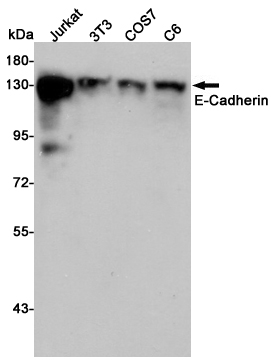
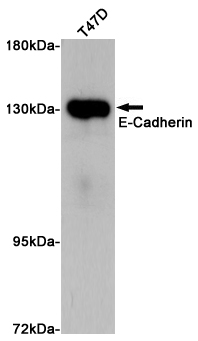
| Calculated MW: 97 kDa; Observed MW: 125-130 kDa | |
| Buffer System | |
| Liquid in PBS containing 50% glycerol, 0.5% BSA and 0.02% sodium azide, pH 7.3. | |
| Storage | |
| Store at 4°C short term. Aliquot and store at -20°C long term. Avoid freeze/thaw cycles. | |
| Recommended Dilution | |
| WB-1:500-1:2000; IHC:-1:100-1:300; IF-1:100-1:300; ELISA-1:20000 | |
| Purification | |
| Affinity Purified | |
| Conjugation | |
| Unconjugated | |
| Modification | |
| Unmodified | |
| Form | |
| Liquid | |
| Background | |
| E-Cadherin is a 120 kDa transmembrane glycoprotein that is localized in the adherens junctions of epithelial cells. There, it interacts with the cytoskeleton through the associated cytoplasmic catenin proteins. In addition to being a calcium-dependent adhesion molecule, E-Cadherin is also a critical regulator of epithelial junction formation. Its association with catenins is necessary for cell-cell adhesion. These E-cadherin/catenin complexes associate with corical actin bundles at both the zonula adherens and the lateral adhesion plaques. Tyrosine phosphorylation can disrupt these complexes, leading to changes in cell adhesion properties. E-Cadherin expression is often down-regulated in highly invasive, poorly differentiated carcinomas. Increased expression of E-Cadherin in these cells reduces invasiveness. Thus, loss of expression or function of E-Cadherin appears to be an important step in tumorigenic progression.Tissue specificity: Non-neural epithelial tissues. | |
Target Information: ( P12830 ) | |
| Name | CDH1 |
| Gene ID | 999 |
| Other Names | |
| CDH1; CDHE; UVO; Cadherin-1; CAM 120/80; Epithelial cadherin; E-cadherin; Uvomorulin; CD antigen CD324 | |


Supporting scientific discovery through quality research products.
ADMEbio is committed to supporting scientific research with high-quality research products and laboratory solutions. We welcome publication submissions from researchers who have used our products in their studies. Your work helps advance scientific discovery and enables us to support the research community.

No publications are currently listed for this product.
Have you used this product in your research?
Submit your publication to help share your work with the scientific community.

Share Your Research
Submit your publications and allow other researchers to discover your work.

Advance Scientific Discovery
Help build a growing body of research that supports the scientific community.

Global Research Community
Your publications contribute to real-world research and innovation.

ADMEbio welcomes feedback from our customers.
Thank you,
ADMEbio Team




