
Hello, Sign in
My Account
My Account
New customer? Start here

| Catalog # | Availability | Size | Quantity | Unit Price | Save For Later Wish List | |
|---|---|---|---|---|---|---|
| ABZ3177-100 | 2 weeks | 100 µL | $499.00 |
Select product before adding to cart
|
||
| ABZ3177-20 | 2 weeks | 20 µL | $149.00 |
Product Overview | |
| Name | SPOP Rabbit mAb |
|---|---|
| Accession (Primary) | O43791 |
| Host Species | Rabbit |
| Clonality | Monoclonal |
| Isotype | IgG |
| Species Reactivity | |
| Reacts With | Human |
| Calculated MW | |
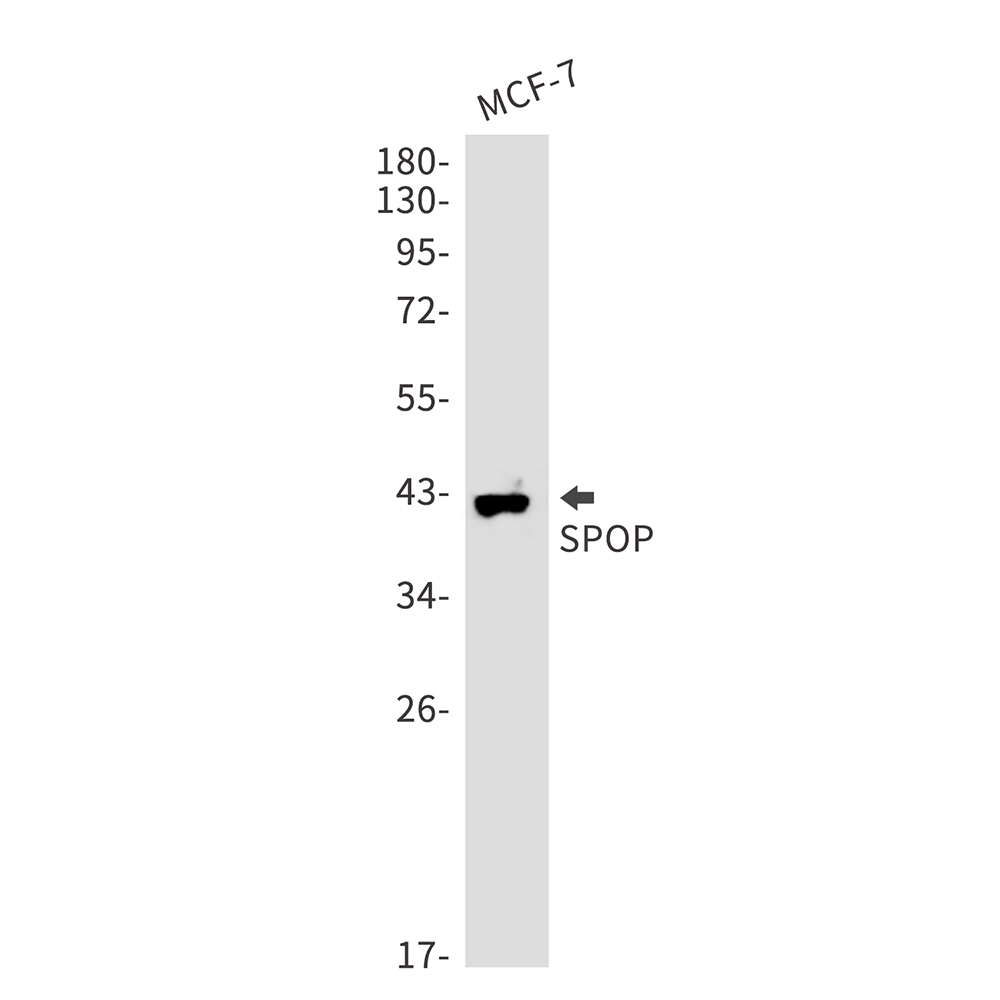
| Calculated MW: 42 kDa; Observed MW: 42 kDa | |
| Buffer System | |
| Liquid in 50mM Tris-Glycine(pH 7.4), 0.15M NaCl, 40%Glycerol, 0.01% sodium azide and 0.05% BSA. | |
| Storage | |
| Store at 4°C short term. Aliquot and store at -20°C long term. Avoid freeze/thaw cycles. | |
| Recommended Dilution | |
| WB-1:500-1:1000 | |
| Purification | |
| Affinity Purified | |
| Conjugation | |
| Unconjugated | |
| Modification | |
| Unmodified | |
| Form | |
| Liquid | |
| Background | |
| The SPOP (TEF2) protein was previously identified as an autoantigen in a patient with scleroderma pigmentosum. SPOP (speckle-type POZ protein), also known as TEF2, HIB homolog 1 or Roadkill homolog 1, is a member of the Tdpoz family containing one N-terminal MATH (Meprin and TRAF Homology) domain and one C-terminal BTB/POZ domain. SPOP can exist as a homodimer and is expressed in a variety of tissues localizing to the nucleus. BTB-mediated SPOP dimers form linear oligomers via BACK domain dimerization, and we determine the concentration-dependent populations of the resulting oligomeric species (PMID: 27220849 ). Through an interaction with CUL-3, SPOP is involved in ubiquitinylation and protein degradation. SPOP specifically interacts with CUL-3 via its BTB/POZ domain and recruits substrates to the CUL-3-based ubiquitin ligase via its MATH domain. Substrates recruited by SPOP and targeted for ubiquitylation via the CUL-3/SPOP complex include PDX-1, Bmi-1, MacroH2A, PIPK II ∫ and Daxx. These substrates are subsequently degraded by the proteasome. In addition, SPOP itself becomes ubiquitylated by the CUL-3-based ubiquitin ligase and is targeted for proteasomal degradation. | |
Target Information: ( O43791 ) | |
| Name | SPOP |
| Gene ID | 8405 |
| Other Names | |
| speckle type POZ protein; Speckle-type POZ protein; TEF2 | |

Thousands of laboratories across the world have published research that depended on the performance of antibodies from ADMEbio to advance their research.
Check out links to articles that cite our products in major peer-reviewed journals, organized by research category.
Thank you,
ADMEbio Team


ADMEbio welcomes feedback from our customers.
Thank you,
ADMEbio Team



