
Hello, Sign in
My Account
My Account
New customer? Start here


| Catalog # | Availability | Size | Quantity | Unit Price | Save For Later Wish List | |
|---|---|---|---|---|---|---|
| ABZ3921-100 | 2 weeks | 100 µL | $499.00 |
Select product before adding to cart
|
||
| ABZ3921-20 | 2 weeks | 20 µL | $149.00 |
Product Overview | |
| Name | Smad2/3 (6F7) Mouse mAb |
|---|---|
| Accession (Primary) | P84022 |
| Host Species | Mouse |
| Clonality | Monoclonal |
| Isotype | IgG |
| Species Reactivity | |
| Reacts With | Human, Mouse, Rat |
| Calculated MW | |
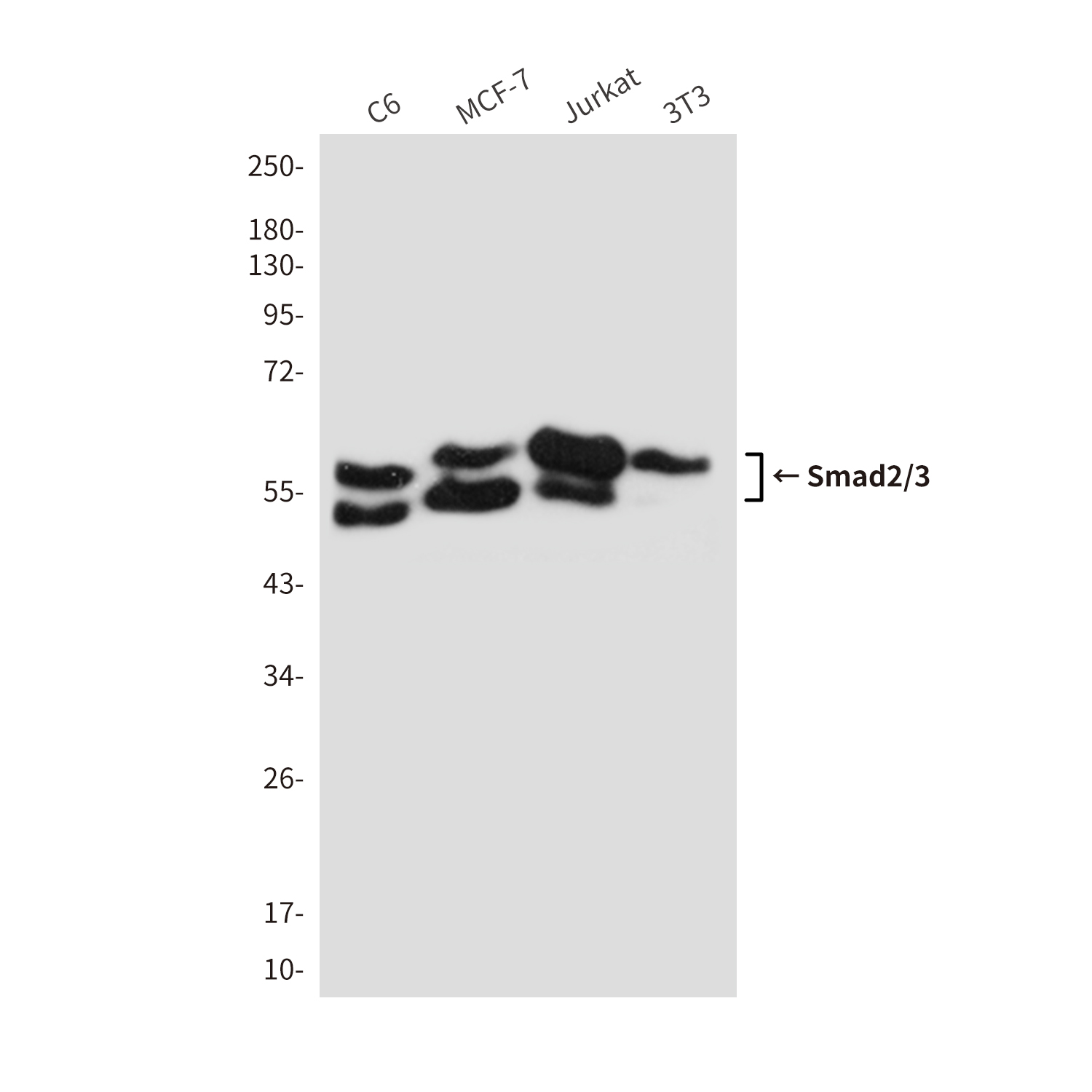
| Calculated MW: 52 kDa; Observed MW: 52,60 kDa | |
| Buffer System | |
| Liquid in PBS containing 50% glycerol, 0.5% BSA and 0.02% sodium azide, pH 7.3. | |
| Storage | |
| Store at 4°C short term. Aliquot and store at -20°C long term. Avoid freeze/thaw cycles. | |
| Recommended Dilution | |
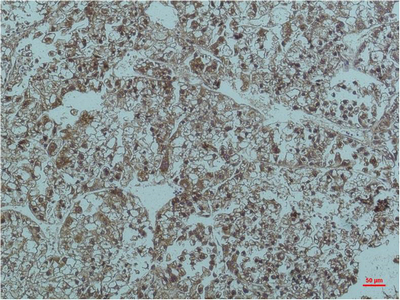
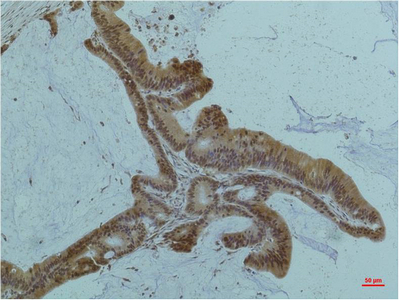
| WB-1:500-1:1000; IHC-1:50-1:100 | |
| Purification | |
| Affinity Purified | |
| Conjugation | |
| Unconjugated | |
| Modification | |
| Unmodified | |
| Form | |
| Liquid | |
| Background | |
| Members of the Smad family of signal transduction molecules are components of a critical intracellular pathway that transmit TGF-β signals from the cell surface into the nucleus. Three distinct classes of Smads have been defined: the receptor-regulated Smads (R-Smads), which include Smad1, 2, 3, 5, and 8; the common-mediator Smad (co-Smad), Smad4; and the antagonistic or inhibitory Smads (I-Smads), Smad6 and 7 . Activated type I receptors associate with specific R-Smads and phosphorylate them on a conserved carboxy terminal SSXS motif. The phosphorylated R-Smad dissociates from the receptor and forms a heteromeric complex with the co-Smad (Smad4), allowing translocation of the complex to the nucleus. Once in the nucleus, Smads can target a variety of DNA binding proteins to regulate transcriptional responses . | |
Target Information: ( P84022 ) | |
| Name | SMAD3/SMAD2 |
| Gene ID | 4087/4088 |
| Other Names | |
| SMAD2; MADH2; MADR2; MAD homolog 2; M hMAD-2; SMAD family member 2; SMAD 2; Smad2; hSMAD2; SMAD3; MADH3; hMAD-3; JV15-2; SMAD family member 3; SMAD 3; Smad3; hSMAD3; smad2/3; smad2+3 | |


Supporting scientific discovery through quality research products.
ADMEbio is committed to supporting scientific research with high-quality research products and laboratory solutions. We welcome publication submissions from researchers who have used our products in their studies. Your work helps advance scientific discovery and enables us to support the research community.

No publications are currently listed for this product.
Have you used this product in your research?
Submit your publication to help share your work with the scientific community.

Share Your Research
Submit your publications and allow other researchers to discover your work.

Advance Scientific Discovery
Help build a growing body of research that supports the scientific community.

Global Research Community
Your publications contribute to real-world research and innovation.

ADMEbio welcomes feedback from our customers.
Thank you,
ADMEbio Team




