
Hello, Sign in
My Account
My Account
New customer? Start here



| Catalog # | Availability | Size | Quantity | Unit Price | Save For Later Wish List | |
|---|---|---|---|---|---|---|
| EKFT19226UV-96 | 2 weeks | 96T | $600.00 |
Select product before adding to cart
|
||
| EKFT19226UV-48 | 2 weeks | 48T | $420.00 |
Product Overview | ||||||||||||||||||||||||||||||||||||||||||||||||||||||||||||||||||||
| Name | peroxidase (POD) Assay Kit | |||||||||||||||||||||||||||||||||||||||||||||||||||||||||||||||||||
|---|---|---|---|---|---|---|---|---|---|---|---|---|---|---|---|---|---|---|---|---|---|---|---|---|---|---|---|---|---|---|---|---|---|---|---|---|---|---|---|---|---|---|---|---|---|---|---|---|---|---|---|---|---|---|---|---|---|---|---|---|---|---|---|---|---|---|---|---|
| Reactivity | Universal | |||||||||||||||||||||||||||||||||||||||||||||||||||||||||||||||||||
| Sensitivity | 1.88 pg/ml | |||||||||||||||||||||||||||||||||||||||||||||||||||||||||||||||||||
| Assay Range | 3.12-200 pmol/ml | |||||||||||||||||||||||||||||||||||||||||||||||||||||||||||||||||||
| Detection Method | Enzyme Catalysis | |||||||||||||||||||||||||||||||||||||||||||||||||||||||||||||||||||
| Sample type(s) | Serum, Plasma, Cell Culture Supernatant, cell or tissue lysate, Other liquid samples | |||||||||||||||||||||||||||||||||||||||||||||||||||||||||||||||||||
| Product Features | ||||||||||||||||||||||||||||||||||||||||||||||||||||||||||||||||||||
| ||||||||||||||||||||||||||||||||||||||||||||||||||||||||||||||||||||
| Principle of the Assay | ||||||||||||||||||||||||||||||||||||||||||||||||||||||||||||||||||||
| This kit is based on enzyme assay method. POD can oxidize TMB to blue solution(max absorption peak: 630nm). The kit offers POD standard and diluent buffer. The standard and diluted sample were added to the wells subsequently. TMB substrates were added into each well to to visualize the enzyme-substrate reaction(blue), which is stopped by adding sulfuric acid solution later. Read the O.D. absorbance at 450nm by spectrophotometry. Compare the OD450 value with standard curve using the curve fitting software, and then the concentration of POD in the sample can be calculated. | ||||||||||||||||||||||||||||||||||||||||||||||||||||||||||||||||||||
| Kit Components and Storage | ||||||||||||||||||||||||||||||||||||||||||||||||||||||||||||||||||||
The sealed kit can be stored at 2-8 ℃.
Note: The liquid reagent bottle contains slightly more reagent than indicated on the label. Please use pipette accurately measure. | ||||||||||||||||||||||||||||||||||||||||||||||||||||||||||||||||||||
| Required Instruments and Reagents | ||||||||||||||||||||||||||||||||||||||||||||||||||||||||||||||||||||
| 1. Microplate reader (wavelength: 450nm) 2. 37°C incubator (CO2 incubator for cell culture is not recommended.) 3. Automated plate washer or multi-channel pipette/5ml pipettor (for manual washing purpose) 4. Precision single (0.5-10μL, 5-50μL, 20-200μL, 200-1000μL) and multi-channel pipette with disposable tips(calibration is required before use.) 5. Sterile tubes and Eppendorf tubes with disposable tips 6. Absorbent paper and loading slot 7. Deionized or distilled water | ||||||||||||||||||||||||||||||||||||||||||||||||||||||||||||||||||||
| Sample Collection and Storage | ||||||||||||||||||||||||||||||||||||||||||||||||||||||||||||||||||||
| 1. Serum Place whole blood sample at room temperature for 2 hours or at 2-8°C overnight. Centrifuge for 20min at 1000xg and collect the supernatant to detect immediately. Or you can aliquot the supernatant and store it at -20°C or -80°C for future’s assay. 2. Plasma EDTA-Na2/K2 is recommended as the anticoagulant. Centrifuge samples for 15 minutes at 1000×g 2-8°C within 30 minutes after collection. Collect the supernatant to detect immediately. Or you can aliquot the supernatant and store it at -20°C or -80°C for future’s assay. For other anticoagulant types and uses, please refer to the sample preparation guideline. 3. Tissue Sample Generally tissue samples are required to be made into homogenization. Protocol is as below: 3.1. Place the target tissue on the ice. Remove residual blood by washing tissue with pre-cooling normal saline (0.9% NaCl). Then weigh for usage. 3.2. Use normal saline (0.9% NaCl) to grind tissue homogenates on the ice. The adding volume of normal saline (0.9% NaCl) depends on the weight of the tissue. Usually, 9mL normal saline (0.9% NaCl) would be appropriate to 1 gram tissue pieces. Some protease inhibitors are recommended to add into the PBS (e.g. 1mM PMSF). 3.3. Do further process using ultrasonic disruption or freeze-thaw cycles (Ice bath for cooling is required during ultrasonic disruption; Freeze-thaw cycles can be repeated twice.) to get the homogenates. 3.4. Homogenates are then centrifuged for 5 minutes at 5000×g. Collect the supernatant to detect immediately. Or you can aliquot the supernatant and store it at -20°C or -80°C for future’s assay. 3.5. Determine total protein concentration by BCA kit for further data analysis. Usually, total protein concentration for Elisa assay should be within 1-3mg/ml. Note: The use of other lysates is not recommended, which can cause precipitation and non-color development during TMB incubation. 4. Cell Culture Supernatant Collect the supernatant: Centrifuge at 2500 rpm at 2-8℃ for 5 minutes, then collect clarified cell culture supernatant to detect immediately. Or you can aliquot the supernatant and store it at -80°C for future’s assay. Cell Lysate Suspension Cell Lysate: Centrifuge at 2500 rpm at 2-8℃ for 5 minutes and collect cells. Then add pre-cooling normal saline (0.9% NaCl) into collected cell and mix gently. Recollect cell by repeating centrifugation. Add 0.5-1ml normal saline (0.9% NaCl) and appropriate protease inhibitor (e.g. PMSF, working concentration: 1mmol/L). Disrupt the cell by ultrasonic disruption on ice. (3~5mm probe, 150-300W, 3~5 s/time, 30s intervals for 1~2s working).. 5.2. Adherent Cell Lysate: Absorb supernatant and add pre-cooling normal saline (0.9% NaCl) to wash three times. Add 0.5-1ml normal saline (0.9% NaCl) and appropriate protease inhibitor (e.g. PMSF, working concentration: 1mmol/L). Scrape the adherent cell with cell scraper. Disrupt the cell by ultrasonic disruption on ice. (3~5mm probe, 150-300W, 3~5 s/time, 30s intervals for 1~2s working).. 5.3. At the end of ultrasonic disruption, centrifuge at 10000rpm at 2-8℃ for 10 minutes. Then, the supernatant is added into EP tube to detect immediately. Or you can aliquot the supernatant and store it at -80°C for future’s assay. Notes: Read notes in tissue sample. 6. Other Biological Sample Centrifuge samples for 15 minutes at 1000×g at 2-8℃. Collect the supernatant to detect immediately. Or you can aliquot the supernatant and store it at -80°C for future’s assay. Recommended reagents for sample preparation: Cat No: E051 100mM PMSF protease inhibitor. | ||||||||||||||||||||||||||||||||||||||||||||||||||||||||||||||||||||
| Notes for Samples | ||||||||||||||||||||||||||||||||||||||||||||||||||||||||||||||||||||
| Blood collection tubes should be disposable and non-endotoxin. Avoid to use hemolyzed and lipemia samples. The best sample storage condition: less than 5 days at 2-8℃; within 6 months at -20℃; within 2 years at -80℃. Stored in liquid nitrogen for a longer storage. When melting frozen samples, rapid water bath at 15-25℃ can decrease the effect of ice crystal (0℃) on the sample. After melting, centrifuge to remove the precipitate, and then mix well. The detection range of this kit is not equivalent to the concentration of analyze in the sample. For analyses with higher or lower concentration, please properly dilute or concentrate the sample. 4. Pretest is recommended for special samples without reference data to validate the validity. | ||||||||||||||||||||||||||||||||||||||||||||||||||||||||||||||||||||
| Precautions for Kits | ||||||||||||||||||||||||||||||||||||||||||||||||||||||||||||||||||||
| 1. When using different Elisa kits, labeling is required to avoid mixed components and failed assay. 2. After opening the kit, please refer to the table of storage condition for coated plate and standards (Dampness may decrease the activity.). If any component is missing or damaged during the assay or storage, please contact us for ordering a new one to replace.(e.g. lyophilized standard) 3. Sterile and disposable tips are required during the assay. After use, the reagents bottle cap has to be tightened to avoid the microbial contamination and evaporation. 4. While manual washing, please keep tips or pipettors for adding wash buffer away from the well. Insufficient washing or contamination easily causes false positive and high background. 5. During the assay, prepare required reagents for next step in advance. After washing, add the reagent into the well in time to avoid dryness. Otherwise, dry plate will result in the failed assay. 6. Before confirmation, reagents from other batches or sources should not be used in this kit. 7. Don't reuse tips and tubes to avoid cross contamination. 8. After loading, seal the plate to avoid the evaporation of the sample during incubation. Complete the incubation process at recommended temperature. 9. Please wear the lab coat, mask and gloves to protect yourself during the assay. Especially, for the detection of blood or other body fluid samples, please follow regulations on safety protection of biological laboratory. | ||||||||||||||||||||||||||||||||||||||||||||||||||||||||||||||||||||
| Recommended Sample Dilution Ratio | ||||||||||||||||||||||||||||||||||||||||||||||||||||||||||||||||||||
Please refer to the following table of recommended dilution ratio for limited samples for reference. (ND: Not Detected)
If other dilution ratio for your sample model is required, please refer to the universal dilution ratio below. (The ratio is suitable for single-well assay. For duplicate assay, please follow the calculation: volume of sample and diluent x number of duplicate well) For 2 fold dilution (1/2): One step dilution. Add 60ul sample into 60ul sample diluent and mix gently. For 5 fold dilution (1/5): One step dilution. Add 24ul sample into 96ul sample diluent and mix gently. For 10 fold dilution (1/10): One step dilution. Add 12ul sample into 108ul sample diluent and mix gently. For 20 fold dilution (1/20): One step dilution. Add 6ul sample into 114ul sample diluent and mix gently. For 50 fold dilution (1/50): One step dilution. Add 3ul sample and 47ul normal saline (0.9% NaCl) into 100ul sample diluent and mix gently. For 100 fold dilution (1/100): One step dilution. Add 3ul sample and 177ul normal saline into 120ul sample diluent and mix gently. For 1000 fold dilution (1/1000): Two step dilution. Create a 50-fold dilution first (normal saline is used throughout the dilution). Then, create a 20-fold dilution and mix gently. For 10000 fold dilution (1/10000): Two step dilution. Create a 100-fold dilution first (normal saline is used throughout the dilution). Then, create the same dilution again and mix gently. For 100000 fold dilution (1/100000): Three step dilution. Create a 50-fold dilution and 20-fold dilution respectively (normal saline is used in the first two steps.) Finally, create a 100-fold dilution and mix gently. Notes: The volume in each dilution is not less than 3ul. Dilution factor should be within 100 fold. Mixing during dilution is required to avoid foaming. | ||||||||||||||||||||||||||||||||||||||||||||||||||||||||||||||||||||
| Reagent Preparation and Storage | ||||||||||||||||||||||||||||||||||||||||||||||||||||||||||||||||||||
| Take the Elisa kit from the fridge around 20 minutes earlier and equilibrate to room temperature(18-25℃). For repeated assays, please just take the strips and standards required for the current assay, store the rest materials according to the relevant condition. 1. Standards 1.1. Zero tube: add 450ul Diluent Buffer into one empty EP tube, then add 50ul 10×POD standard and mix well(Working solution after preparation: 1x POD standard, 200pmol/ml). 1.2. Standard dilution: Label 7 EP tubes with 1/2, 1/4, 1/8, 1/16, 1/32, 1/64 and blank respectively. Add 0.3ml of the sample dilution buffer into each tube. Add 0.3ml solution from zero tube into 1/2 tube and mix them thoroughly. Transfer 0.3ml from 1/2 tube into 1/4 tube and mix them thoroughly. Transfer 0.3ml from 1/4 tube into 1/8 tube and mix them thoroughly, so on till 1/64 tube. Now blank tube only contain 0.3ml sample dilution buffer. The standard concentration from zero tube to blank tube is 200pmol/ml, 100pmol/ml, 50pmol/ml, 25pmol/ml, 12.5pmol/ml, 6.25pmol/ml, 3.125pmol/ml, 0pmol/ml. 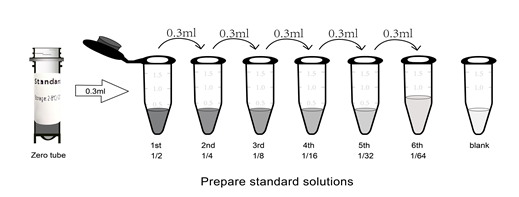 Notes: Store the zero tube with dissolved standards at 2-8℃ and use it within 12h. Other diluted working solutions containing standards should be used in 2h. | ||||||||||||||||||||||||||||||||||||||||||||||||||||||||||||||||||||
| Calculation of Results | ||||||||||||||||||||||||||||||||||||||||||||||||||||||||||||||||||||
| 1. Calculate the mean OD450 value (using the original OD450 value or the corrected OD450 value) of the duplicate readings for each standard, control, and sample. Then, obtain the value of calculation by subtracting the OD450 blank. 2. Create a four parameter logistic curve by plotting the mean absorbance for each standard on the y-axis against the concentration on the x-axis. (Remove the OD450 blank during plotting.) Alternatively, you can use the curve fitting software offered by the microplate reader (e.g. Thermo SkanIt RE software, Curve Expert 1.3 or 1.4). 3. Calculate the sample concentration by substituting OD450 value into the standard curve. Diluted samples should be multiplied by the relevant dilution ratio. | ||||||||||||||||||||||||||||||||||||||||||||||||||||||||||||||||||||
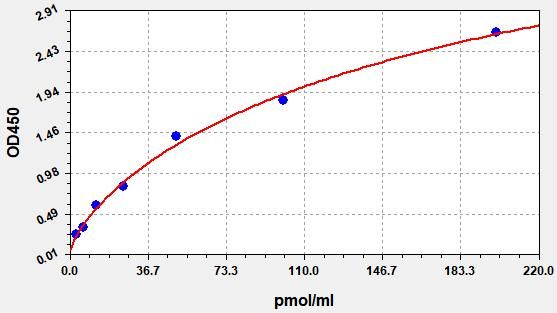
| Typical Data & Standard Curve | ||||||||||||||||||||||||||||||||||||||||||||||||||||||||||||||||||||
| This product has been tested by Quality Control Department and meets performance specifications mentioned in the manual. (The humidity in the laboratory is 20%-60%, and the temperature is 18°C -25°C. TMB was balanced to 37°C before color development, and incubated at 37°C for 15 minutes in the dark after adding the enzyme label plate holes.) The following assay data are provided for reference, since experimental environment and operation are different. The establishment of standard curve depends on your own assay.
 | ||||||||||||||||||||||||||||||||||||||||||||||||||||||||||||||||||||
| Precision | ||||||||||||||||||||||||||||||||||||||||||||||||||||||||||||||||||||
| Intra-assay Precision: samples with low, medium and high concentration are tested 20 times on same plate. Inter-assay Precision: samples with low, medium and high concentration are tested 20 times on three different plates.
| ||||||||||||||||||||||||||||||||||||||||||||||||||||||||||||||||||||
| Recovery | ||||||||||||||||||||||||||||||||||||||||||||||||||||||||||||||||||||
Add a certain amount of POD into the sample. Calculate the recovery by comparing the measured value with the expected amount of POD in the sample.
| ||||||||||||||||||||||||||||||||||||||||||||||||||||||||||||||||||||
| Linearity | ||||||||||||||||||||||||||||||||||||||||||||||||||||||||||||||||||||
Dilute the sample with a certain amount of POD at 1:2, 1:4 and 1:8 to get the recovery range.
| ||||||||||||||||||||||||||||||||||||||||||||||||||||||||||||||||||||
| Stability | ||||||||||||||||||||||||||||||||||||||||||||||||||||||||||||||||||||
Perform the stability test for the sealed kit at 37°C and 2-8°C and get relevant data.
| ||||||||||||||||||||||||||||||||||||||||||||||||||||||||||||||||||||
| ELISA Troubleshooting | ||||||||||||||||||||||||||||||||||||||||||||||||||||||||||||||||||||
If the ELISA result is unsatisfied, please take a screenshot for the staining result and store the OD data. Keep used strips as well the rest reagents. Contact us to solve your problem with the kit’s catalogue number and batch number. You can also refer to the following table to check the reason.
| ||||||||||||||||||||||||||||||||||||||||||||||||||||||||||||||||||||
| Declaration | ||||||||||||||||||||||||||||||||||||||||||||||||||||||||||||||||||||
| Limited to current conditions and scientific techniques, all raw materials are not completely identified and analyzed. This product may have a technology-related quality risk. During the Elisa kit development, some endogenous interferons(not all) in the biological sample have been removed or decreased. The final assay result is related to the validity of reagents, experimental operation and environment. Our company is only responsible for this kit, excluding sample consumption during using this kit. Before use, please consider and prepare enough samples required by the assay. To get a satisfied assay result, please use all reagents offered by this kit. Don't use any product from other vendors. Strictly follow instructions of this manual. During assay procedure, incorrect reagents preparation and parameter setting of the microplate reader may result in the abnormal result. Before assay, please read this manual carefully and adjust instruments. Even if the assay is performed by the same person, results in two independent assays may be different. Thus, each step in the assay should be controlled to ensure the reproducibility. Before delivery, this kit is subject to the strict QC. Influenced by transportation conditions and experimental devices, the assay result got by the customer may be different from original data. Inter-assay CV between different batches may be caused by reasons before. This kit is not compared to similar kits from other vendors or methods for testing the same detection target. Thus, assay results may be inconsistent. This kit allows for research use only. For IVD or other purposes, our company is not responsible for relevant consequences and doesn't bear any legal liability. | ||||||||||||||||||||||||||||||||||||||||||||||||||||||||||||||||||||
| Assay Procedure | ||||||||||||||||||||||||||||||||||||||||||||||||||||||||||||||||||||
| When diluting samples and reagents, they must be mixed completely and evenly. Before adding TMB into wells, equilibrate TMB Substrate for 30 minutes at 37°C. It is recommended to plot a standard curve for each test. Step 1: Set standard, test samples, control (blank) wells on the pre-coated plate respectively, and then, records their positions. It is recommended to measure each standard and sample in duplicate. Step 2: Add Samples: Add 100ul of properly diluted sample or standard into relevant wells. Step 3: TMB Substrate: Add 100ul TMB Substrate into each well, cover the plate and incubate at 37°C in dark for 20 minutes. Step 4: Stop: Add 50ul Stop Solution into each well. The color will turn yellow immediately. The adding order of Stop Solution should be as the same as the TMB Substrate Solution. Step 5: OD Measurement: Read the O.D. absorbance at 450nm in a microplate reader immediately. (If your microplate reader has a choice of correction wavelength, set it to 570nm or 630nm. Correct the read value to the OD450 value minus the OD570 or OD630 value. In this way, the OD value of non-chromogenic substances can be corrected and removed, thus obtaining more accurate results. If the microplate reader does not have a 570nm or 630nm wavelength, the original OD450 value can be used.) | ||||||||||||||||||||||||||||||||||||||||||||||||||||||||||||||||||||
Background |
Peroxidase (POD) is a kind of oxidase widely present in various animals, plants and microorganisms. H2O2 is used as electron acceptor to oxidize phenols or amines directly, which can eliminate the toxicity of hydrogen peroxide and phenolamines. Peroxidase (POD) is one of the key enzymes in the enzymatic defense system of plants under stress conditions. It works synergically with superoxide dismutase (SOD) and catalase (CAT) to remove excess free radicals in the body, thereby improving plant stress resistance. In addition, POD can oxidize and decompose indoleacetic acid (IAA), thus affecting plant growth and development. Peroxidase can also convert some carbohydrates contained in tissues into lignin, increasing the degree of lignification, so peroxidase can be used as a physiological indicator of tissue aging. |

Thousands of laboratories across the world have published research that depended on the performance of antibodies from ADMEbio to advance their research.
Check out links to articles that cite our products in major peer-reviewed journals, organized by research category.
Thank you,
ADMEbio Team


ADMEbio welcomes feedback from our customers.
Thank you,
ADMEbio Team



