
Hello, Sign in
My Account
My Account
New customer? Start here



| Catalog # | Availability | Size | Quantity | Unit Price | Save For Later Wish List | |
|---|---|---|---|---|---|---|
| EKFT19263UV-96 | 2 weeks | 96T | $600.00 |
Select product before adding to cart
|
||
| EKFT19263UV-48 | 2 weeks | 48T | $420.00 |
Product Overview | ||||||||||||||||||||||||||||||||||||||||||||||
| Name | Protein A Elisa Kit | |||||||||||||||||||||||||||||||||||||||||||||
|---|---|---|---|---|---|---|---|---|---|---|---|---|---|---|---|---|---|---|---|---|---|---|---|---|---|---|---|---|---|---|---|---|---|---|---|---|---|---|---|---|---|---|---|---|---|---|
| Reactivity | Universal | |||||||||||||||||||||||||||||||||||||||||||||
| Sensitivity | 46.88 pg/ml | |||||||||||||||||||||||||||||||||||||||||||||
| Assay Range | 78.13-5,000 pg/ml | |||||||||||||||||||||||||||||||||||||||||||||
| Detection Method | Sandwich ELISA, Double Antibody | |||||||||||||||||||||||||||||||||||||||||||||
| Sample type(s) | Serum, Plasma, Cell Culture Supernatant, cell or tissue lysate, Other liquid samples | |||||||||||||||||||||||||||||||||||||||||||||
| Principle of the Assay | ||||||||||||||||||||||||||||||||||||||||||||||
| This kit used a double antibody sandwich ELISA method, and the experiment lasted for 2 hours. The microplate in the kit was precoated with an antibody against Protein A. The biotin-detection antibody was added to the well plate, and then the acidified standard, the moderately diluted sample to be tested were added to the corresponding Wells, and the unbound components were washed off after incubation. HRP-streptavidin (SABC) was added. Then the unbound components were washed away and TMB chromogenic substrate was added, which appeared blue under the catalysis of horseradish peroxidase (HRP) and turned yellow after adding the reaction termination solution. OD values were measured at 450 nm using a microplate reader. The concentration of Protein A in the samples was calculated by drawing a standard curve. There is a direct ratio between the concentration of the target substance and the OD450 value. | ||||||||||||||||||||||||||||||||||||||||||||||
| Kit Components and Storage | ||||||||||||||||||||||||||||||||||||||||||||||
The sealed kit can be stored at 2-8 ℃. The storage condition for opened kit is specified in the table below:
Note: The liquid reagent bottle contains slightly more reagent than indicated on the label. Please use pipette accurately measure and do proportional dilution. | ||||||||||||||||||||||||||||||||||||||||||||||
| Required Instruments and Reagents | ||||||||||||||||||||||||||||||||||||||||||||||
| 1. Microplate reader (wavelength: 450nm) 2. Automated plate washer or multi-channel pipette/5ml pipettor (for manual washing purpose) 3. Precision single (0.5-10μL, 5-50μL, 20-200μL, 200-1000μL) and multi-channel pipette with disposable tips(calibration is required before use.) 4. Sterile tubes and Eppendorf tubes with disposable tips 5. Absorbent paper and loading slot 6. Deionized or distilled water | ||||||||||||||||||||||||||||||||||||||||||||||
| Reagent Preparation and Storage | ||||||||||||||||||||||||||||||||||||||||||||||
| Take the Elisa kit from the fridge around 20 minutes earlier and equilibrate to room temperature(18-25℃). For repeated assays, please just take the strips and standards required for the current assay, store the rest materials according to the relevant condition. Wash Buffer Dilute 30ml concentrated wash buffer to 300ml wash buffer with deionized or distilled water and mix well. (The recommended resistivity of ultrapure water is 18MΩ.) Alternatively, take appropriate amount of concentrated wash buffer according to the assay requirement, then create a 25-fold dilution and mix well. Store the rest solution at 2-8℃. Crystals formed in the concentrated wash buffer can be heated by water bath at 40℃ till complete dissolution. (Heating temperature should be below 50℃.) Mix well for the next step. It's better to use up the prepared wash buffer in one day. Store the rest buffer at 2-8℃ within 48h. 2. Standards 2.1. The concentration of the concentrated standard vial was 50μg/mL, 0.1ml. 2.2. Gradient dilution: Nine EP tubes were taken and labeled as tubes 1-9, respectively. 990μL of sample diluent was added to tubes 1 and 2, and 300μl of sample diluent was added to tubes 3-9. 10μl of the concentrated standard was added to tube 1, vortexed and mixed, and then 10μl was added to tube 2 and vortexed and mixed. Then, 300μl of liquid in tube 2 was added to tube 3 and vortexed to mix, and 300μl of liquid in tube 3 was vortexed to tube 4 and vortexed to mix until tube 8. Note that EP tube 9 contains only the sample diluent. At this time, the concentration of standard material in 8 EP tubes from tube 2 to tube 9 was 5000pg/ml, 2500pg/ml, 1250pg/ml, 625pg/ml, 312.5pg/ml, 156.25pg/ml, 78.125pg/ml and 0pg/ml, respectively. Once the standards and samples are ready, the Sample treatment procedure is entered. 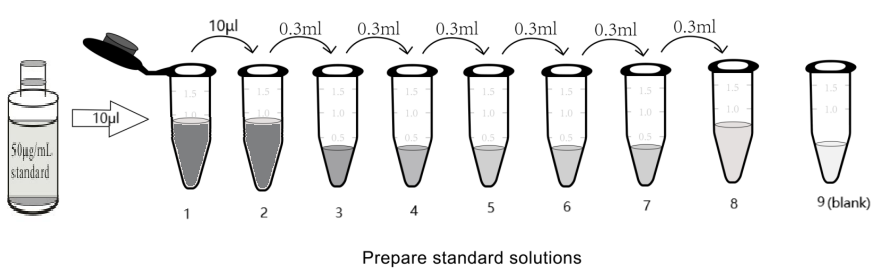 3. Sample treatment 3.1 If the sample needs to be diluted, please use the sample diluent in the kit to dilute in a 96-well plate or EP tube. 3.2. Add 100μl of surrogate sample to each sample processing well (tube). 3.3. Add 100μl of standard substance and quality control substance to the corresponding hole (tube). 3.4. Add 50μl of acidifying solution to each well, and use the pipettor to blow and mix at least 15 times (if EP tube is used, EP tube can be vortexed for a few seconds). 3.5. Place at room temperature for 5-10min (to separate proteinA and antibody in the sample by acidification). | ||||||||||||||||||||||||||||||||||||||||||||||
| Assay Procedure Summary | ||||||||||||||||||||||||||||||||||||||||||||||
| Step 1: Add 100ul of biotin-antibody working solution into each well, and then add 25μl of acidified treated standards, samples, quality controls, and blanks to the corresponding Wells. seal the plate and static incubate for 60 min at room temperature. Wash board: Wash board 4 times. Pat dry. Step 2: Add 100ul HRP-streptavidin (SABC) working solution, seal the plate and static incubate for 10 minutes at room temperature. Wash board: Wash board 4 times. Pat dry. Step 4:100ul of TMB chromogenic substrate was added. Seal the plate and static incubate for 10-20 minutes at room temperature (Accurate TMB visualization control is required.). Step 5: Add 100ul of the reaction termination solution. Read at 450nm immediately and calculate. | ||||||||||||||||||||||||||||||||||||||||||||||
| Detailed Assay Procedure | ||||||||||||||||||||||||||||||||||||||||||||||
| When diluting samples and reagents, they must be mixed completely. It's recommended to plot a standard curve for each test. 1. Set standard, pilot samples, control (blank) wells on the pre-coated plate respectively, and then, records their positions. It's recommended to measure each standard and sample in duplicate to decrease experimental errors. 2. Add 100ul biotin-labeled antibody working solution into each well, then add 25ul acidified gradient standard to the standard well, add 25ul moderately diluted and acidified tested sample to the sample well, and add 25ul acidified sample diluent to the blank well. Seal the plate and static incubate for 60 minutes at room temperature. 3. Wash twice: Remove the cover, then absorb the liquid in the plate or tap the plate on a clean absorbent paper two or three times. Add 250ul wash buffer into each well. Discard the liquid in the well and tap on the absorbent paper again. Repeat the washing step quartic. 4. Add 100ul SABC working solution into each well. Seal the plate and static incubate for 10 minutes at room temperature. 5. Remove the cover, and then wash the plate with wash buffer quartic times. Read washing method in step 5. 6. Add 100ul TMB Substrate into each well, seal the plate and static incubate at room temperature in dark within 10-20 minutes. Run the microplate reader and preheat for 15min. (Notes: Please do not use the reagent reservoirs used by HRP couplings. The reaction time can be shortened or extended according to the actual color change, but not more than 30 minutes. You can terminate the reaction when apparent gradient appeared in standard wells. Weaker or stronger color intensity is unacceptable. Please refer to TMB color rendering control in page 2 or QR code for detail.) 9. Keep the liquid in the well after staining. Add 100ul stop solution into each well. The color will turn yellow immediately. The order for adding stop solution and TMB substrate solution is the same. 10. OD Measurement: Read the O.D. absorbance at 450nm in a microplate reader immediately. (If your microplate reader has a choice of correction wavelength, set it to 570nm or 630nm. Correct the read value to the OD450 value minus the OD570 or OD630 value. In this way, the OD value of non-chromogenic substances can be corrected and removed, thus obtaining more accurate results. If the microplate reader does not have a 570nm or 630nm wavelength, the original OD450 value can be used.) | ||||||||||||||||||||||||||||||||||||||||||||||
| Calculation of Results | ||||||||||||||||||||||||||||||||||||||||||||||
| 1. Calculate the mean OD450 value (using the original OD450 value or the corrected OD450 value) of the duplicate readings for each standard, control, and sample. Then, obtain the value of calculation by subtracting the OD450 blank. 2. Create a four parameter logistic curve by plotting the mean absorbance for each standard on the y-axis against the concentration on the x-axis. (Remove the OD450 blank during plotting.) Alternatively, you can use the curve fitting software offered by the microplate reader 3. Calculate the sample concentration by substituting OD450 value into the standard curve. Diluted samples should be multiplied by the relevant dilution ratio. | ||||||||||||||||||||||||||||||||||||||||||||||
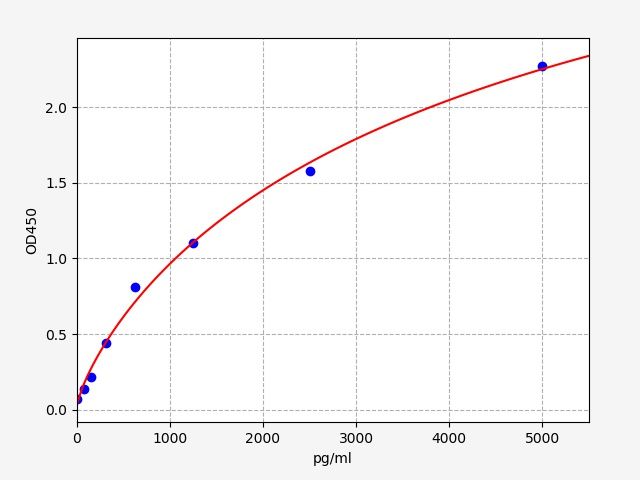
| Typical Data & Standard Curve | ||||||||||||||||||||||||||||||||||||||||||||||
The following assay data are provided for reference, since experimental environment and operation are different. The establishment of standard curve depends on your own assay.
 Refine Results 1. Precision: when the sample concentration is greater than 300pg/ml, the detection coefficient of variation is less than 10%; When the sample concentration was less than 300pg/ml, the coefficient of variation was slightly more than 10%. 2. It is recommended to use the method of adding quality control materials to monitor the influence of sample matrix effect on the test results when detecting specific samples. 3. The sensitivity of this kit is 20pg/ml. 4. Hook effect: This kit is a double-antibody sandwich one-step method, and the concentration of the hook effect is 10μg/ml. | ||||||||||||||||||||||||||||||||||||||||||||||
| Declaration | ||||||||||||||||||||||||||||||||||||||||||||||
| Limited to current conditions and scientific techniques, all raw materials are not completely identified and analyzed. This product may have a technology-related quality risk. During the Elisa kit development, some endogenous interferons(not all) in the biological sample have been removed or decreased. The final assay result is related to the validity of reagents, experimental operation and environment. Our company is only responsible for this kit, excluding sample consumption during using this kit. Before use, please consider and prepare enough samples required by the assay. To get a satisfied assay result, please use all reagents offered by this kit. Don't use any product from other vendors. Strictly follow instructions of this manual. During assay procedure, incorrect reagents preparation and parameter setting of the microplate reader may result in the abnormal result. Before assay, please read this manual carefully and adjust instruments. Even if the assay is performed by the same person, results in two independent assays may be different. Thus, each step in the assay should be controlled to ensure the reproducibility. Before delivery, this kit is subject to the strict QC. Influenced by transportation conditions and experimental devices, the assay result got by the customer may be different from original data. Inter-assay CV between different batches may be caused by reasons before. This kit is not compared to similar kits from other vendors or methods for testing the same detection target. Thus, assay results may be inconsistent. This kit allows for research use only. For IVD or other purposes, our company is not responsible for relevant consequences and doesn't bear any legal liability. | ||||||||||||||||||||||||||||||||||||||||||||||

Thousands of laboratories across the world have published research that depended on the performance of antibodies from ADMEbio to advance their research.
Check out links to articles that cite our products in major peer-reviewed journals, organized by research category.
Thank you,
ADMEbio Team


ADMEbio welcomes feedback from our customers.
Thank you,
ADMEbio Team



