Hello, Sign in
My Account
My Account
New customer? Start here

| Catalog # | Availability | Size | Quantity | Unit Price | Save For Later Wish List | |
|---|---|---|---|---|---|---|
| ABZ1918-100 | 2 weeks | 100 µL | $499.00 |
Select product before adding to cart
|
||
| ABZ1918-20 | 2 weeks | 20 µL | $149.00 |
Product Overview | |
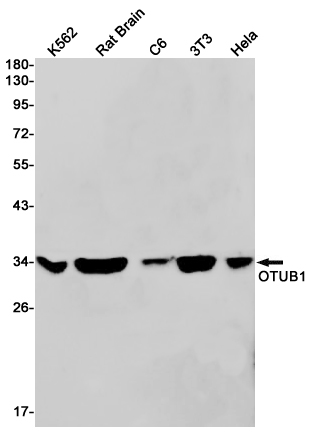
| Name | OTUB1 Rabbit mAb |
|---|---|
| Accession (Primary) | Q96FW1 |
| Host Species | Rabbit |
| Clonality | Monoclonal |
| Isotype | IgG |
| Species Reactivity | |
| Reacts With | Human, Mouse, Rat |
| Calculated MW | |
| Calculated MW: 31 kDa; Observed MW: 31 kDa | |
| Buffer System | |
| Liquid in 50mM Tris-Glycine(pH 7.4), 0.15M NaCl, 40%Glycerol, 0.01% sodium azide and 0.05% BSA. | |
| Storage | |
| Store at 4°C short term. Aliquot and store at -20°C long term. Avoid freeze/thaw cycles. | |
| Recommended Dilution | |
| WB-1:1000-1:5000; IP-1:10-1:100 | |
| Purification | |
| Affinity Purified | |
| Conjugation | |
| Unconjugated | |
| Modification | |
| Unmodified | |
| Form | |
| Liquid | |
| Background | |
| Hydrolase that can specifically remove 'Lys-48'-linked conjugated ubiquitin from proteins and plays an important regulatory role at the level of protein turnover by preventing degradation. Regulator of T-cell anergy, a phenomenon that occurs when T-cells are rendered unresponsive to antigen rechallenge and no longer respond to their cognate antigen. Acts via its interaction with RNF128/GRAIL, a crucial inductor of CD4 T-cell anergy. Isoform 1 destabilizes RNF128, leading to prevent anergy. In contrast, isoform 2 stabilizes RNF128 and promotes anergy. Surprisingly, it regulates RNF128-mediated ubiquitination, but does not deubiquitinate polyubiquitinated RNF128. Deubiquitinates estrogen receptor alpha (ESR1). Mediates deubiquitination of 'Lys-48'-linked polyubiquitin chains, but not 'Lys-63'-linked polyubiquitin chains. Not able to cleave di-ubiquitin. Also capable of removing NEDD8 from NEDD8 conjugates, but with a much lower preference compared to 'Lys-48'-linked ubiquitin.Plays a key non-catalytic role in DNA repair regulation by inhibiting activity of RNF168, an E3 ubiquitin-protein ligase that promotes accumulation of 'Lys-63'-linked histone H2A and H2AX at DNA damage sites. Inhibits RNF168 independently of ubiquitin thioesterase activity by binding and inhibiting UBE2N/UBC13, the E2 partner of RNF168, thereby limiting spreading of 'Lys-63'-linked histone H2A and H2AX marks. Inhibition occurs by binding to free ubiquitin: free ubiquitin acts as an allosteric regulator that increases affinity for UBE2N/UBC13 and disrupts interaction with UBE2V1. The OTUB1-UBE2N/UBC13-free ubiquitin complex adopts a configuration that mimics a cleaved 'Lys48'-linked di-ubiquitin chain.MiscellaneousIn the structure described by PubMed:18954305, the His-265 active site of the catalytic triad is located too far to interact directly with the active site Cys-91. A possible explanation is that OTUB1 is in inactive conformation in absence of ubiquitin and a conformation change may move His-265 in the proximity of Cys-91 in presence of ubiquitin substrate. | |
Target Information: ( Q96FW1 ) | |
| Name | OTUB1 |
| Gene ID | 55611 |
| Other Names | |
| OTUB1; OTB1; OTU1; HSPC263; Ubiquitin thioesterase OTUB1; Deubiquitinating enzyme OTUB1; OTU domain-containing ubiquitin aldehyde-binding protein 1; Otubain-1; hOTU1; Ubiquitin-specific-processing protease OTUB1 | |

Thousands of laboratories across the world have published research that depended on the performance of antibodies from ADMEbio to advance their research.
Check out links to articles that cite our products in major peer-reviewed journals, organized by research category.
Thank you,
ADMEbio Team


ADMEbio welcomes feedback from our customers.
Thank you,
ADMEbio Team