
Hello, Sign in
My Account
My Account
New customer? Start here
Sandwich and competitive ELISA both use antibody binding to measure a target, but they generate and interpret signals differently. A sandwich assay generally measures a target captured between two compatible antibodies; a competitive assay measures how the sample changes binding in a competition reaction. The right format depends on the analyte, the available reagents, the sample, and the kit’s documented performance—not on a claim that one format is universally better. [1–3] Direct and indirect ELISA formats also exist; this guide compares two commonly encountered approaches to quantitative kit selection.
This guide focuses on research-use assay selection. It does not establish suitability for clinical diagnosis. For broader kit-selection considerations, see How to Choose the Right ELISA Kit for Your Research.
Quick answer — Sandwich ELISA typically uses two compatible antibodies to capture and detect an analyte and is often suitable for proteins with accessible binding sites. Competitive ELISA measures competition for binding and is often useful for small molecules or targets that cannot support simultaneous two-antibody recognition. Neither format guarantees better performance for every target; compare kit-specific specifications and supporting evidence.
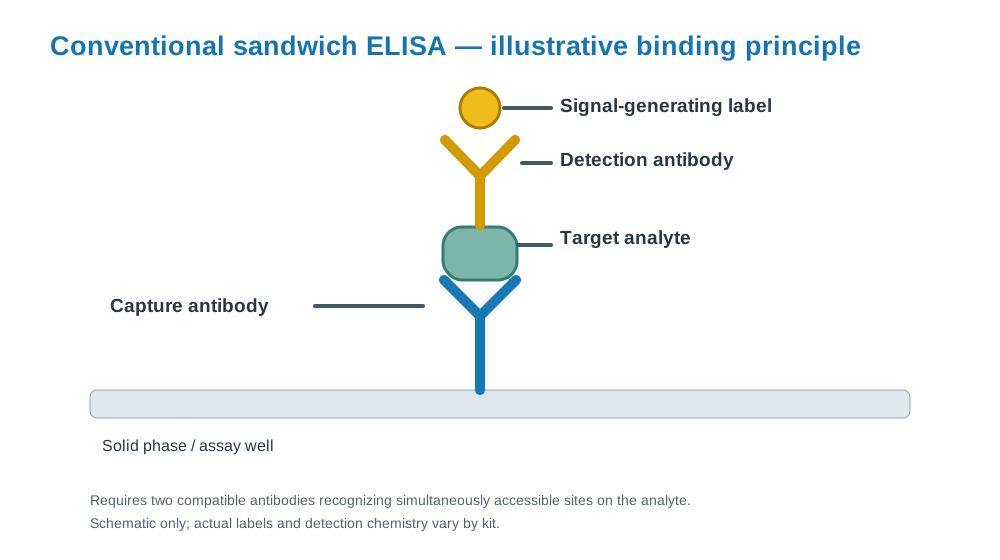
In a typical sandwich ELISA, an immobilized capture antibody binds the analyte from the sample. A second, detection antibody recognizes a separate accessible site on the captured analyte. The detection system produces a measurable signal. Within the assay’s supported measurement interval, more analyte generally produces more signal. [1,2]
A conventional two-site sandwich assay requires a compatible antibody pair and enough accessible binding sites for simultaneous recognition. Two antibodies recognizing the same or overlapping epitope may interfere with one another. Protein size alone does not prove suitability: epitope accessibility, analyte form, and antibody-pair performance matter. [1,3]
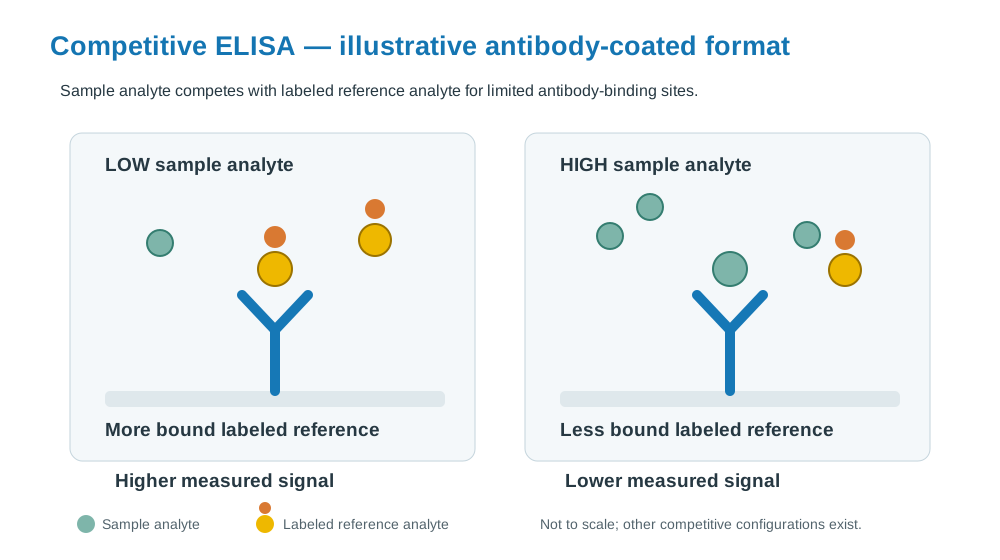
In a common competitive ELISA design, sample analyte competes with a reference analyte for a limited number of antibody-binding sites. Depending on the assay configuration, the reference analyte may be labeled or immobilized on the plate. As sample analyte increases, the measured signal associated with the competing reference typically decreases. Thus, many competitive ELISAs have an inverse signal–concentration relationship. [1,2]
Competitive assays have multiple configurations, so the plate coating, tracer, and detection steps vary. The inverse-signal explanation applies to the common competitive designs described here; always use the selected kit’s protocol and calibration curve rather than assuming every assay produces the same raw signal pattern. [1]
Competition can be useful for small molecules or targets that cannot readily accommodate two simultaneously binding antibodies. This is a common design advantage, not an absolute rule: specialized noncompetitive immunoassay formats for certain small molecules and haptens have been reported in the literature. [3,4]
| Selection question | Sandwich ELISA (typical) | Competitive ELISA (typical) |
|---|---|---|
| Binding arrangement | Two compatible antibodies bind distinct accessible sites on target. | Sample analyte competes with a reference or labeled component for binding. |
| Signal trend | Signal generally increases with analyte in the supported interval. | Signal commonly decreases as sample analyte increases. |
| Target suitability | Often suitable for proteins with accessible sites for two antibodies. | Often useful for small molecules or targets with limited accessible epitopes. |
| Key reagent requirement | Validated capture/detection antibody pairing. | Well-characterized competitor, antibody, and calibration setup. |
| Can you assume better sensitivity? | No; compare actual performance data for the target and matrix. | No; compare actual performance data for the target and matrix. |
| Interpreting unknowns | Use the supplied standard curve and valid range. | Use the supplied inverse-response calibration and valid range. |
The comparison describes common implementations, not universal performance guarantees. Neither format inherently establishes sensitivity, specificity, precision, recovery, or suitability for a particular sample matrix. [1,2]
For a protein biomarker, a conventional sandwich kit may be a practical starting point if the product documentation supports the relevant target form and sample type. For a small molecule or hapten, competitive formats are often worth examining first because conventional two-site binding may be difficult. These are starting points, not automatic decisions. [3,4]
Confirm the target identity, species/reactivity where relevant, analyte form, and potential cross-reactivity. For proteins, ask whether the assay detects free, bound, processed, or multimeric forms if those distinctions matter to the study. For competitive formats, inspect the standard curve direction and the meaning of the reported concentration. Product documentation may name a variant, such as a double-antibody sandwich assay or a sandwich assay using indirect detection. Check the described binding arrangement rather than relying on the label alone.
Use the kit’s stated assay range and the underlying evidence for quantification, not the assay format as a proxy for sensitivity. Consider sample dilution, sample matrix, precision, and recovery near the concentrations your experiment needs. For an explanation of detection limits, quantification ranges, and dilution calculations, see ELISA Sensitivity vs. Detection Range: What Matters?
Example A — Measuring a soluble protein in human plasma: a sandwich kit could be appropriate if the intended protein form, plasma matrix, and concentration range are supported. A kit described as “sandwich” alone does not prove any of these conditions.
Example B — Measuring a small-molecule analyte: a competitive kit may be appropriate when simultaneous two-antibody binding is impractical. Review the actual competition design, cross-reactivity profile, standard curve, and relevant matrix evidence before ordering.
These are hypothetical decisions, not recommendations for a specific ADMEbio product. The format alone cannot determine whether an assay will meet a particular study’s requirements.
Not as a rule you can apply to a specific kit. Published reviews describe general sensitivity advantages for sandwich formats when a suitable antibody pair is available, helping explain interest in noncompetitive assays for small molecules. [3,4] That does not guarantee superior sensitivity for a particular target, antibody pair, sample matrix, or measurement criterion. Compare kit-specific performance evidence rather than assuming the general pattern applies to your assay. [1]
In many competitive designs, more sample analyte leaves less labeled or immobilized competitor associated with the measured binding event. The resulting signal decreases as sample concentration increases. Confirm the specific configuration in the kit instructions. [1,2]
A conventional two-site sandwich assay is often unsuitable when the target cannot bind two antibodies simultaneously. Specialized noncompetitive methods for small molecules exist, however, so “small molecule” is a strong design clue rather than an absolute prohibition. [3,4]
No. Sample compatibility and measurement performance must be supported by documentation or appropriate evaluation. The format explains the binding principle, not the complete validation status.
Explore ADMEbio’s ELISA kit catalog and compare each candidate’s stated format, target, sample requirements, and available performance documentation. If a key definition or supporting detail is missing or inaccessible, contact ADMEbio technical support before ordering. Share the target, species, sample type, expected concentration range, and any preparation constraints so the relevant documentation can be reviewed.
